 Andrew
On a busy site, you don’t lose time on big mistakes—you lose it in small, repeated cycles. Dumpers and loaders tighten those cycles when you match machine size to access, bucket to payload, and routes to ground conditions. You cut waiting, reduce rehandling, and keep materials flowing with fewer passes and less spillage. But the real productivity gains show up when you plan the haul, stage stockpiles, and prevent downtime…
Where Dumpers and Loaders Save Time Fastest
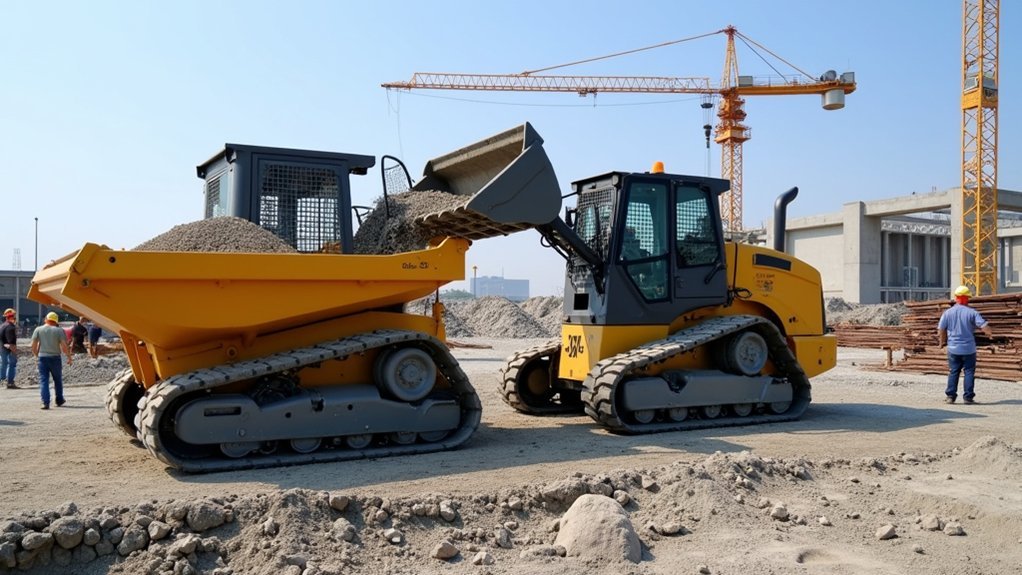
Although most crews focus on raw hauling capacity, dumpers and loaders save time fastest at the handoff points—loading, travel, and tipping—where small inefficiencies compound every cycle.
You cut queue time when the loader matches bucket size to the dumper’s Material capacity, so you hit target payload in fewer passes without spillage or rework.
You also reduce travel losses by keeping haul roads graded and spotters consistent, letting operators hold steady speeds and tighter turning radii.
At the tip, you gain minutes by standardizing approach angles, dump heights, and clear-out zones so beds empty cleanly and you avoid double-tipping.
Finally, you protect cycle time with disciplined Equipment maintenance: tire pressure, hydraulics, and pins drift before failures, so you schedule service around utilization, not breakdowns.
Choose the Right Dumper for Site Access
Fast loading and clean tipping don’t matter if your dumper can’t move efficiently through the site. Start by auditing access restrictions: gate widths, scaffold corridors, turning radii, overhead limits, and one-way traffic plans.
If you’re tight on space, a swivel skip or high-tip can reduce reversing and cut collision risk, while an articulated chassis keeps you tracking through bends.
Next, map terrain challenges by zone, not by average conditions. Track gradients, soft subgrade, wet clay, and kerb crossings.
Specify traction and stability accordingly: 4×4 drive, diff lock, wider tyres, or tracked units where ground pressure matters.
Finally, right-size payload to haul roads; oversizing causes rutting, delays, and higher hire and fuel cost.
Match Loaders to Stockpiles and Loadout
When you match a loader to the way material sits in your stockpiles and the way it leaves site, you cut cycle time long before you touch operator technique.
Start with Stockpile segmentation: separate by size, moisture, and destination so you’re not remixing in the bucket. Then choose bucket capacity and breakout force to suit the densest cut, not the average, and confirm dump height and reach for your trucks, hoppers, or conveyors.
Use Loader calibration to standardize heaped capacity, scale accuracy, and hydraulic response so each pass hits target payload without extra top-offs.
Watch tire selection and lift geometry; they decide push-in speed and clean-up efficiency. The payoff is fewer passes, less spillage, and predictable loadout tempo all shift.
Plan Dumper Routes to Cut Travel Time
You cut cycle time fastest when you optimize haul road layout for speed, grade, and turning radii, not just distance.
You’ll see immediate gains by removing bottlenecks, standardizing one-way segments where possible, and positioning passing bays to protect peak-hour flow.
You also tighten productivity when you coordinate loading and dumping windows so trucks arrive on rhythm and neither the loader nor the tip area sits idle.
Optimize Haul Road Layout
Although equipment horsepower grabs attention, haul road layout often determines whether your dumpers deliver peak productivity or burn hours in transit. Start with haul road design that matches cycle times: minimize deadhead distance, eliminate tight reverses, and keep grades consistent so you don’t lose speed or traction. Use one-way loops where feasible, size turning radii to your largest dumper, and specify surface compaction to reduce rolling resistance and tire wear.
You’ll also gain by separating flows. Plan material segregation with dedicated lanes or spurs for spoil, aggregates, and clean fill, so trucks don’t cross-contaminate stockpiles or queue behind mismatched loads. Add clear signage, berms, and passing bays at pinch points, and review GPS cycle data weekly to rebalance routes as the site evolves.
Coordinate Loading And Dumping
Because loaders and dumpers rarely run at the same cadence, route planning has to coordinate the loading face, haul path, and dump point as one system—otherwise you’ll trade travel minutes for queue time.
Map cycle times by payload class, then assign dumpers to dedicated loops with clear passing zones and no blind reversals. You’ll cut deadhead distance by placing the dump point on the natural exit line, not the convenient one.
Stage waiting bays off the haul lane so loaders never starve.
Enforce Material compatibility at the dump area with signed stockpiles and a spotter to prevent cross-contamination and rehandle.
Track Environmental impact by minimizing idling, avoiding soft-ground detours, and timing runs to reduce dust and noise peaks.
Review GPS heatmaps weekly and rebalance routes fast.
Use Dumpers and Loaders to Reduce Rehandling
To reduce rehandling, you need dumpers and loaders working as a single system that moves material once—from extraction to final placement.
You cut double handling by staging stockpiles, setting loader pickup points, and timing dumper arrivals so you don’t create idle heaps that require a second move.
You streamline on-site flow when every pass is planned, every bucket count is tracked, and every load lands where it’s needed next.
Minimize Material Double Handling
When you move the same material twice, you’re paying for extra machine hours, fuel burn, and operator time without adding output. Use dumpers to deliver aggregates, spoil, and pallets directly to their point-of-use, and use loaders to stage only what the crew will place that shift. That cuts queue time and reduces damage from reloading, especially on tight margins and fixed-price packages.
Build Material segregation into your loading plan: separate spoil, sub-base, and recyclables at the face so you don’t re-sort later with a loader. Size the dumper to the haul and match bucket capacity to reduce partial loads.
Finally, protect uptime with disciplined Equipment maintenance—greased pins, tire checks, and clean radiator packs—so you don’t trigger rehandling during unplanned downtime.
Streamline On-Site Material Flow
Even if your production rates look strong on paper, a messy on-site flow quietly drains them through short hauls, idle operators, and constant repositioning. You fix it by designing a one-way movement plan where loaders feed dumpers at a single, stable pick point and dumpers deliver to clearly marked drop zones.
Set strict Material segregation: separate spoil, aggregate, and recycled material so you don’t contaminate stockpiles or trigger re-sorting. Use loaders to build tidy, accessible piles and keep dumpers on continuous circuits, not hunting for space.
Match bucket size and dumper payload to avoid half-loads and excess trips. Protect uptime with disciplined Equipment maintenance—daily walkarounds, greasing, tire checks, and scheduled refuels—so your flow stays predictable and crews stay productive.
Avoid Downtime With Daily Dumper and Loader Checks
Because a single overlooked fault can idle an entire crew, daily dumper and loader checks act like low-cost insurance for your production targets. Build daily maintenance into the start-of-shift routine: walkarounds, fluid levels, tyre or track condition, lights, alarms, pins, hoses, and bucket or skip wear.
Log defects immediately so you can plan parts and avoid reactive call-outs that blow your margin.
Pair this with disciplined safety checks that reduce stoppages from incidents and enforcement: brakes, steering response, mirrors, reversing aids, and leak detection around hot components. You’ll also spot early warning signals—slow hydraulics, unusual vibration, overheating—before they cascade into breakdowns.
When you standardise checklists and keep spares on site, you cut idle time, protect utilisation, and keep material flow predictable.
Train Operators to Run Dumpers and Loaders Safely
Daily checks keep machines available, but operator behaviour decides whether that availability turns into steady output or unplanned stoppages. You get productivity when you standardise how people mount, start, load, tip, and park, not when you rely on “experienced hands.”
Train for operator safety with short, repeatable modules: stability limits, ground assessment, spotter signals, reversing rules, and exclusion zones. Use telematics and near-miss reports to target coaching where risk and cost cluster.
You’ll also protect equipment maintenance budgets by teaching operators to feel early warning signs: sluggish hydraulics, brake fade, steering play, abnormal vibration, and overheating. Make shutdown criteria non-negotiable, and reward timely defect reporting.
Finally, run practical assessments on real routes and benches, so safe habits survive peak pressure.
Frequently Asked Questions
What Insurance and Licensing Are Required to Operate Dumpers and Loaders?
You’ll need operator licensing/certification per local licensing regulations, plus equipment and liability insurance; employers often require workers’ comp too. Like a $20k claim I’ve seen, operator safety slips without coverage and documented training.
Should We Rent or Buy Dumpers and Loaders for Short-Term Projects?
You should rent dumpers and loaders for short-term projects; you’ll avoid tied-up capital and maintenance risk. Do Cost analysis on rates, delivery, downtime, and utilization. Buying only wins if Equipment lifespan supports high reuse.
How Do Fuel Costs Compare Between Tracked and Wheeled Machines?
You’ll usually pay more fuel with tracked machines on firm haul routes, while wheeled units win on Fuel efficiency at higher speeds. On soft, steep ground, tracks narrow the gap. Emission standards can further sway costs.
What Are the Typical Lead Times for Parts and Servicing Support?
You’ll typically see 24–72 hours for stocked parts availability, 1–3 weeks for backordered items; servicing support often books 2–7 days out, depending on servicing frequency, dealer density, and contract SLAs.
How Do Emissions Rules Affect Which Dumpers and Loaders We Can Use?
Environmental regulations and emission standards limit which dumpers and loaders you can run, pushing you toward Stage V/Tier 4 Final engines or electrics. You’ll factor jobsite zones, retrofit costs, availability, and resale compliance.