 Andrew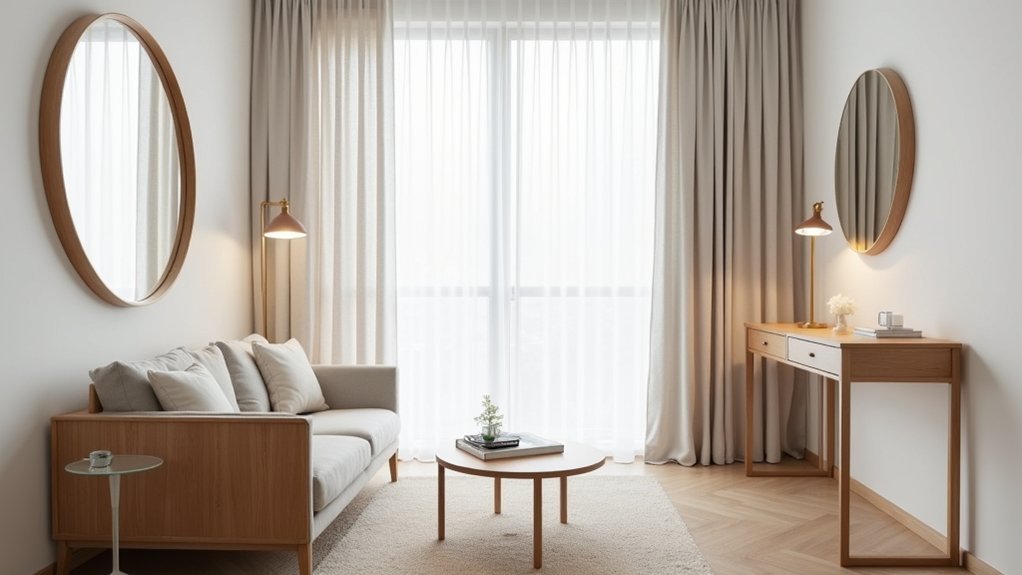
In a 300‑square‑foot studio, one wall mirror can double perceived brightness like a second window. You don’t need more space—you need better decisions: measure every wall, keep furniture on legs, and choose pieces that convert, stack, or hide storage. Place mirrors opposite daylight, layer warm lighting to erase dark corners, and use airy curtains to keep sightlines open. The payoff is immediate, but one mistake can undo it all…
Measure Your Small Space Like a Pro
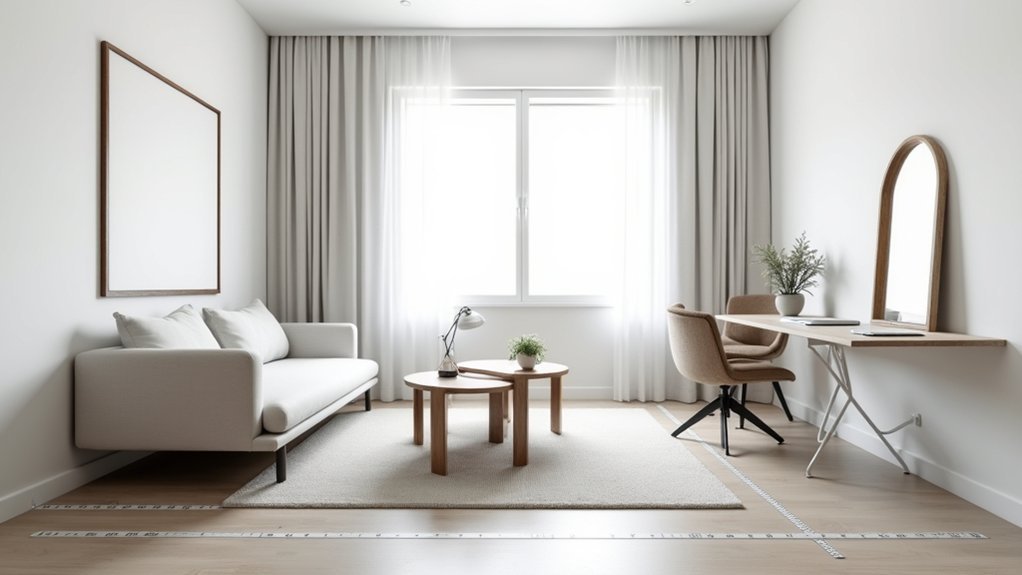
Before you buy a single piece of furniture, measure your space with the same rigor you’d use for a renovation: capture the room’s length, width, and ceiling height, then map every fixed constraint—doors (including swing direction), windows, baseboards, radiators, outlets, and vents—with exact dimensions.
Next, plot a to-scale floor plan (1/4 in = 1 ft) and add clearances: 30–36 inches for main paths, 18 inches between seating and tables, and 6–10 inches from furniture to heat sources.
Measure diagonals to catch out-of-square walls. Record sightlines from entry and seating; they’ll guide color contrast so the room reads open, not choppy.
Finally, mark maximum footprints and heights to control furniture scale before you shop or rearrange.
Pick Smart Furniture for Small Spaces
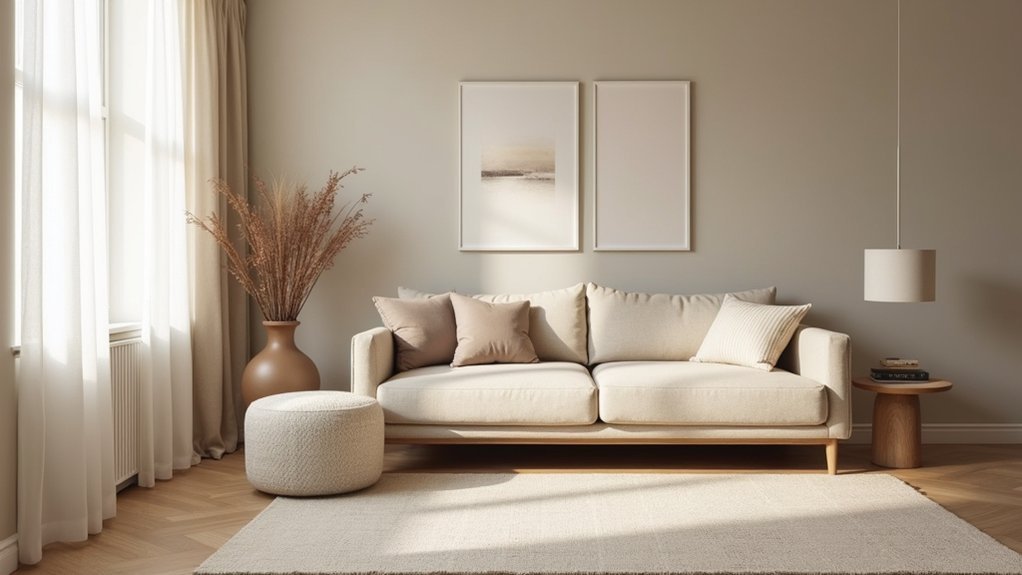
Once you’ve mapped your room’s true footprint and clearances, choose furniture that earns its square footage with the right scale and function. Aim for visual lightness: pieces on legs expose more floor, which makes the room read larger.
In Compact living, depth matters—keep sofas around 34–38 inches deep, and pick armless or tight-arm profiles to preserve inches without losing seating.
Use Multifunctional furniture that changes use, not just size: a drop-leaf table that seats two daily and four occasionally, or a nesting coffee table set that expands only when needed.
Prioritize closed silhouettes and simple lines to reduce visual noise.
Finally, protect circulation: keep 30–36 inches for main walkways and 18 inches between seating and tables.
Add Storage Ottomans and Hidden Storage
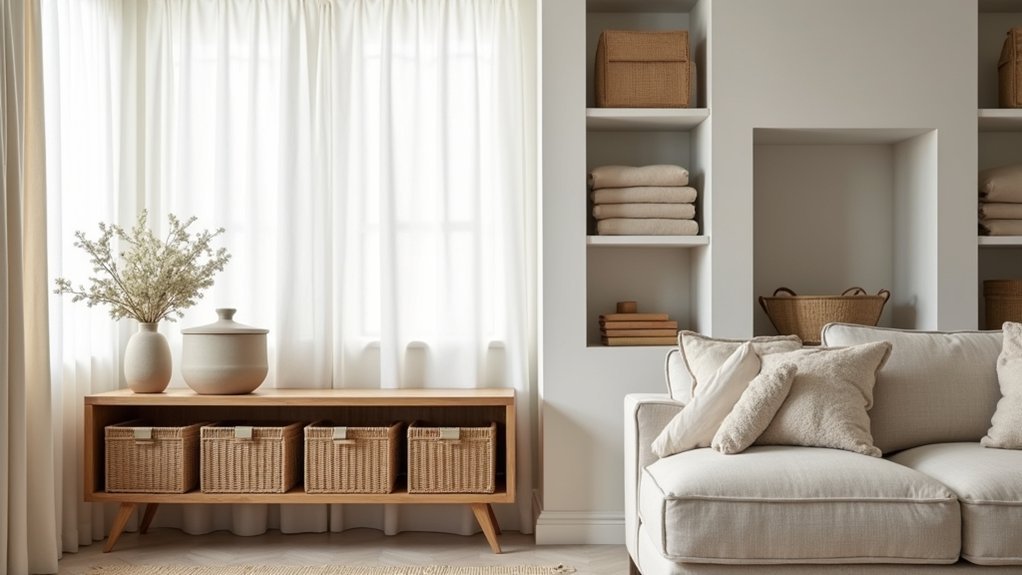
Smart, right-sized furniture sets the foundation, but hidden storage keeps a small room functional day to day. Choose a storage ottoman that holds at least 10–15 gallons; that’s enough for two throws, a board game stack, and spare cables. Prioritize lift-top lids with safety hinges so you can open it one-handed without pinched fingers.
Use hidden compartments in coffee tables or bed frames to keep high-visual-clutter items—chargers, remotes, paperwork—out of sight and off surfaces. Add multifunctional benches in entryways or at the foot of the bed; you’ll gain seating plus a drop zone for shoes and bags.
Aim to store 70–80% of small items behind doors or lids to maintain a calmer sightline.
Use Nesting Tables and Stackable Seating
Although you need surfaces and seating every day, you don’t need them taking up floor space all the time—nesting tables and stackable chairs let you scale up only when you’re using them.
Choose nesting tables with at least 2–3 sizes; you’ll get a coffee-table footprint when nested, then triple the surface area for guests. Prioritize thin legs and rounded corners to improve walk paths and reduce bruises in tight layouts.
For stackable seating, measure first: allow roughly 18–22 inches per chair width and keep a 30–36 inch route clear. Pick chairs that stack 4–6 high and store them in a closet or under a console.
Add felt pads so you can move pieces quietly, without scuffing floors.
Try Wall-Mounted Desks and Floating Shelves
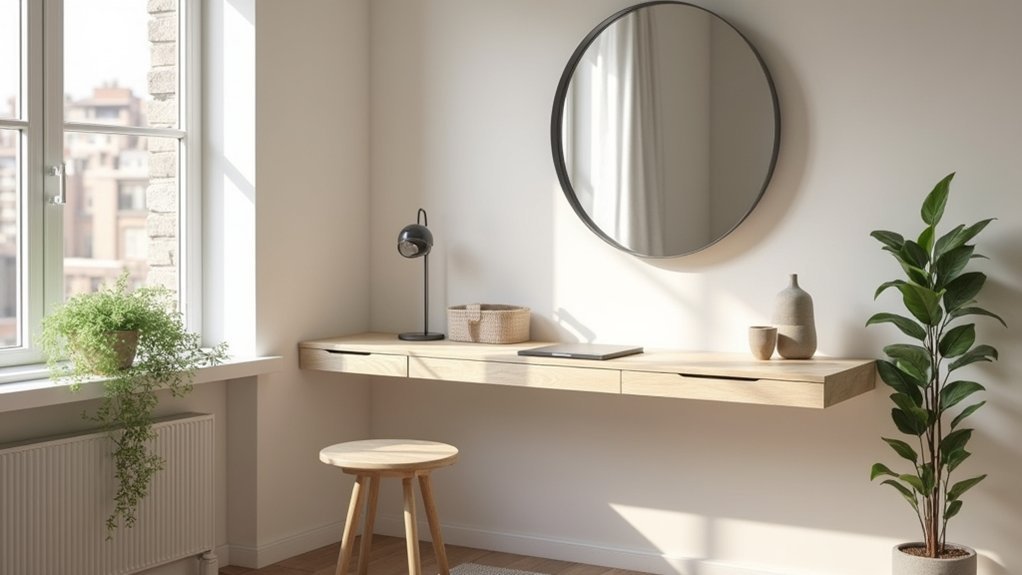
When your floor plan can’t spare another square foot, mount your work surface and storage on the wall instead. Wall mounted desks free leg room, improve traffic flow, and keep the visual field open—key in rooms under 200 sq ft.
Choose a fold-down model rated for at least 50 lb, and place it 28–30 inches high for ergonomic typing. Anchor brackets into studs or use toggles rated above your load. Add cable clips and a slim task light to prevent cord clutter and shadowing.
Floating shelves extend storage vertically without bulky bookcases. Install the first shelf 12–16 inches above the desk, then stagger additional shelves 10–12 inches apart. Keep depths to 8–10 inches so you don’t crowd your headspace.
Choose Sofa Beds and Daybeds That Convert
Choose a sofa bed or daybed with fast, tool-free conversion so you can shift from seating to sleeping in minutes without sacrificing floor space.
Prioritize designs with built-in storage, slim arms, and a true mattress thickness that supports nightly use, not just occasional guests.
Style it as your primary sofa with tailored bedding, a structured throw, and two firm back cushions so it looks intentional even when it’s pulling double duty.
Space-Saving Conversion Features
Because every square foot has to earn its keep in a small home, conversion pieces like sofa beds and daybeds deliver two core functions—seating and sleeping—without doubling your furniture footprint.
Prioritize Multifunctional furniture with a mattress thickness of 4–6 inches for nightly use, and check the mechanism: click-clack and pull-out frames typically need 12–24 inches of clearance in front. Measure your pathway too; a queen sleeper can add 80–90 inches of extended length.
Look for Modular design features that cut setup time: split cushions that stay attached, under-seat storage for bedding, and replaceable covers.
Choose models rated for 250+ lb per seat and metal crossbars to reduce sag.
Finally, confirm weight: lighter frames (<150 lb) move easier in rentals.
Dual-Purpose Comfort Styling
Although sofa beds and daybeds earn their keep on paper, you’ll feel the difference only if you style them for real comfort in both modes.
Start with a mattress or topper that hits 4–5 inches for daily sleep, or add a 2-inch high-density foam layer to stop bar feel-through.
Choose a seat depth around 22–24 inches for lounging, then use a lumbar pillow set to restore posture when it’s upright.
Build a cozy zone with a washable throw, two pillow sizes (20-inch + 12×20), and a rug that extends at least 12 inches beyond the frame to anchor it.
For multifunctional furniture, pick slipcovers and fitted sheets in the same color family so the conversion looks intentional, not improvised.
Use Mirrors to Brighten Small Spaces
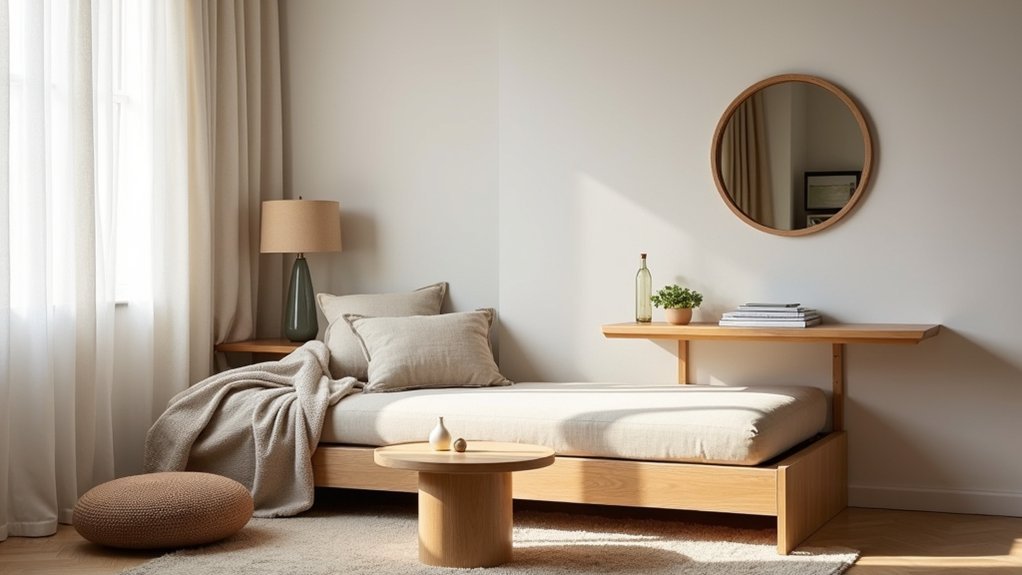
You can make a small room feel noticeably larger by placing mirrors where they bounce daylight and key sightlines—typically opposite or adjacent to windows and across from focal points.
Choose reflective styles and frames that match your room’s visual weight: thin metal or frameless for a cleaner, lighter look; thicker wood for warmth without adding clutter.
Then layer light by pairing mirrors with lamps or sconces so you multiply illumination and reduce shadowy corners.
Mirror Placement Strategies
When natural light is limited, strategic mirror placement can increase perceived brightness by redirecting daylight deeper into the room. Place a mirror opposite or 90° to your brightest window to bounce light across primary sightlines; designers often target a “double-light” effect where the reflected window reads like a second opening.
Use mirror placement strategies to amplify task zones: hang one beside a desk or kitchen prep area so it catches side light, not your own shadow.
For depth, mount a tall mirror at the end of a narrow hallway to extend the visual axis.
Apply reflective surface positioning with intent: angle mirrors to reflect pale walls, not clutter, and keep the mirror’s center near eye level for maximum impact.
Reflective Styles And Frames
How much brighter can a small room feel with the right mirror style and frame? In tight spaces, you don’t need bigger furniture—you need smarter surfaces. Choose high-clarity glass with a silver backing; it reflects more accurately than tinted or antiqued options and keeps colors true.
Among reflective styles, flat-polished mirrors give the cleanest bounce, while beveled edges add definition without visual bulk. Skip heavy distressing in dim rooms; it absorbs contrast and reads smaller.
Your frame choices should match function: slim metal frames maximize reflective area; light wood warms without closing in; frameless designs disappear and expand sightlines. Use 1–2 inch profiles for most walls.
If you want impact, pick a single oversized frame with a thin border, not multiple chunky ones.
Layering Light With Mirrors
Because light behaves like a resource in small rooms, mirrors work best as part of a layered plan: place one opposite the strongest daylight source to double effective illumination. Then add a second mirror or mirrored surface near task lighting (a desk lamp or under-cabinet LEDs) to push usable light deeper into corners.
Keep mirrors within the lamp’s throw zone (about 3–6 feet) for measurable bounce, and aim them at pale walls or ceilings to reduce glare. Choose larger reflective surfaces over many small pieces; fewer seams create stronger mirror illusions and a cleaner sightline.
Tilt mirrors slightly downward if you’re reflecting a window to avoid hot spots. Finally, pair mirrors with high-CRI bulbs so reflected light keeps colors accurate in tight layouts.
Layer Lighting to Remove Dark Corners
Why do small rooms feel cramped even after you declutter? Uneven lighting leaves pockets of low visibility, and your brain reads those dark corners as “lost space.” Fix it by layering three light levels.
First, build an ambient glow with a ceiling fixture or flush-mount that delivers even coverage; aim for warm-white 2700–3000K and enough lumens to avoid contrasty shadows.
Second, add task illumination where you work: a swing-arm sconce at the desk, an under-cabinet strip at the kitchenette, or a floor lamp by the chair.
Third, use low-output accent lights to wash vertical surfaces and corners—plug-in uplights or LED bars behind furniture work fast.
Put each layer on separate switches or dimmers to tune brightness by time of day.
Choose Light-Enhancing Décor and Airy Curtains
Even with solid lighting, your room can still look dim if surfaces and textiles absorb most of the light. Shift the balance by choosing high-reflectance finishes: semi-gloss paint and satin trim bounce more light than flat.
Place one large mirror opposite a window to redirect daylight deeper into the room.
Pick light-enhancing décor with pale woods, clear acrylic, and metal accents; they visually “lift” a tight footprint without adding bulk.
Swap heavy drapes for airy curtains in white or warm ivory; sheers can preserve privacy while letting in usable daylight.
Hang the rod 4–6 inches above the frame and extend it past the window so fabric stacks off the glass.
Keep rugs low-pile and light-toned to reduce light loss.
Frequently Asked Questions
What Paint Finishes Make Small Rooms Feel Larger and Brighter?
Choose eggshell or satin—they bounce more light, making small rooms feel larger and brighter. One study found gloss can reflect up to 70% more light than matte finishes; use reflective surfaces strategically, sparingly.
How Can Renters Improve Lighting Without Rewiring or Permanent Fixtures?
Use plug-in solutions: add portable lamps with high-lumen LED bulbs (800–1,600 lumens), place them at corners, bounce light off walls, and hang sheer curtains to boost daylight. Use stick-on puck lights under cabinets.
Which Rug Sizes and Patterns Best Visually Expand a Small Room?
Cut to the chase: go larger—an 8’x10′ (or 9’x12′) rug under front legs unifies space; smart area rug selection boosts perceived area. Favor low-contrast stripes or small-scale geometrics; avoid busy, high-contrast pattern choices.
How Do I Reduce Echo and Noise in a Compact Apartment?
You’ll cut echo by adding soft, porous surfaces: rugs, upholstery, and bookcases. Install Acoustic panels at first-reflection points; hang Soundproof curtains over windows. Seal gaps with weatherstripping. Target 30–40% wall coverage.
What Are the Best Pet-Friendly Materials for Space-Saving Furniture?
Like a telegram, choose tightly woven microfiber, canvas, or performance velvet: they resist claws and stains. Use pet safe fabrics with removable covers, and prioritize sustainable materials like bamboo plywood or FSC birch for durable frames.